
If you are considering ketamine therapy for chronic pain, one of the first questions that comes up is how often do you get ketamine infusions for pain. The short answer is that most patients begin with a series of infusions over one to two weeks, followed by maintenance treatments spaced weeks or months apart.
The exact schedule depends on your diagnosis, your response to treatment, and your physician’s protocol. Ketamine is not taken daily like a pill. It is administered strategically in phases, and understanding those phases helps you plan for both short term relief and long term management.
Understanding How Ketamine Works in Pain Management
Before discussing frequency, it helps to understand why ketamine is used in chronic pain care at all. Ketamine was originally approved by the United States Food and Drug Administration as an anesthetic and remains widely used in surgical settings. Over time, pain specialists began using it off label for certain difficult to treat pain conditions.
Unlike opioids, ketamine does not primarily work on opioid receptors. It blocks N methyl D aspartate, or NMDA, receptors in the brain and spinal cord. These receptors are involved in amplifying pain signals and in a process known as central sensitization, where the nervous system becomes overly reactive. By targeting abnormal pain signaling pathways, ketamine can reduce both pain intensity and hypersensitivity rather than simply masking symptoms.
The American Society of Regional Anesthesia and Pain Medicine has issued consensus guidelines supporting the use of intravenous ketamine infusions for select chronic pain conditions when conventional treatments have failed. These guidelines emphasize careful patient selection and medical supervision. Because ketamine works by modulating nervous system activity, the effects tend to build over a series of treatments rather than after a single infusion.
That is why frequency is structured in phases.

The Loading Phase: Why Treatments Are Clustered Early
Most pain clinics begin with what is commonly referred to as a loading phase. This is an initial series of infusions given close together, usually within one to two weeks. The purpose is to interrupt persistent pain signaling and establish a therapeutic baseline.
What a Typical Loading Schedule Looks Like
Although protocols vary by clinic, many physicians recommend three to six infusions over one to two weeks. Each session may last anywhere from 40 minutes to several hours depending on the condition being treated.
Patients are monitored throughout the infusion for blood pressure, heart rate, and side effects such as nausea or dissociation. This controlled environment is important because ketamine affects the central nervous system.
The loading phase is designed to create cumulative changes in the nervous system, not to deliver permanent relief after one appointment. Some patients notice improvement after the first infusion, while others require the full series before significant pain reduction becomes apparent.
Why Multiple Sessions Are Necessary
Chronic pain often involves long standing changes in how the brain processes signals. These changes do not reverse instantly. Repeated infusions over a short time frame appear to produce more sustained results than a single isolated treatment.
Clinical guidance from pain societies emphasizes that dosing and frequency during this phase should be individualized. Higher doses are not automatically better. Instead, physicians aim for a balance between effectiveness and safety.
Once the loading phase is complete, the schedule shifts into maintenance.
Maintenance Infusions: How Often After the Initial Series?
After the initial cluster of treatments, patients move into a maintenance phase. This is where the question of how often do you get ketamine infusions for pain becomes more individualized.
For many patients, maintenance infusions are scheduled every four to eight weeks. Others may go two to three months between treatments. A smaller group may require more frequent sessions if their pain returns quickly.
Maintenance timing is based on how long meaningful relief lasts after the initial series. If pain relief consistently fades at six weeks, the next infusion may be scheduled at five weeks to prevent a full flare.
There is no universal schedule. Instead, physicians evaluate:
- The severity and type of pain condition
- How long relief lasts after each infusion
- Functional improvements such as mobility and sleep
- Side effects or tolerability
- Other therapies being used
Some clinics gradually extend the interval between infusions to determine whether relief remains stable. If symptoms remain controlled, treatments may become less frequent over time.
Comparing Loading and Maintenance Phases
Understanding the difference between these phases clarifies why frequency changes.
| Phase | Frequency | Purpose | Duration |
| Loading Phase | Several infusions over 1 to 2 weeks | Reset abnormal pain signaling | Short term intensive |
| Maintenance Phase | Every 4 to 12 weeks, individualized | Sustain pain control | Long term ongoing |
This structure highlights that ketamine therapy is not continuous daily medication. It is a periodic intervention aimed at resetting pain processing pathways.
How Different Conditions Influence Infusion Frequency
Chronic pain is not a single diagnosis. The underlying cause significantly influences how often infusions are needed.
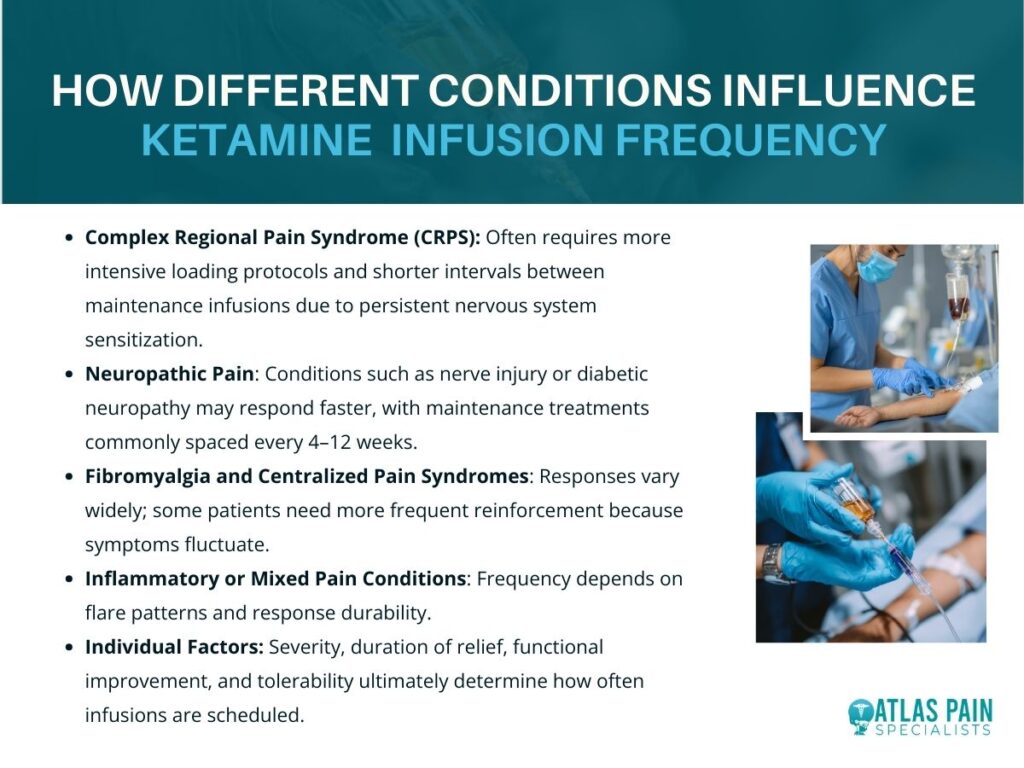
Complex Regional Pain Syndrome
Complex regional pain syndrome, often abbreviated as CRPS, is one of the conditions most commonly associated with ketamine therapy. Pain specialists and anesthesia societies recognize that CRPS may require more intensive initial treatment.
Some patients with CRPS undergo longer infusion sessions or higher cumulative doses during the loading phase. Maintenance infusions may still be required because CRPS involves persistent nervous system dysregulation.
Neuropathic Pain
Neuropathic pain related to nerve injury, diabetic neuropathy, or post surgical nerve damage may respond more quickly. Patients often transition to maintenance infusions every one to three months depending on their response.
Fibromyalgia and Centralized Pain
Fibromyalgia and other centralized pain syndromes are more variable. Some patients report meaningful relief lasting several weeks. Others require more consistent reinforcement.
The specific diagnosis matters because ketamine modifies pain processing rather than repairing structural damage. That difference explains why frequency varies widely across patients.
What Happens If Infusions Are Stopped?
Patients often wonder whether pain will immediately return if treatments stop. In most cases, relief gradually diminishes rather than disappearing overnight.
Ketamine does not permanently cure chronic pain. Instead, it changes how the nervous system processes signals. If the underlying condition remains active, symptoms may eventually resurface.
Some patients are able to extend the time between infusions over months or years. Others find that consistent maintenance provides the most stable relief. Decisions about discontinuation should always be made in consultation with a pain specialist.
Safety and Monitoring With Repeated Infusions
Repeated ketamine infusions are generally considered safe when administered in a monitored medical setting. Professional societies emphasize careful screening and ongoing evaluation.
Patients typically undergo:
- Blood pressure monitoring during each session
- Periodic assessment of liver function when clinically indicated
- Review of mental health history
- Evaluation of functional improvement
The United States Food and Drug Administration has approved ketamine as an anesthetic, and off label use for pain must follow medical standards of care. Long term safety depends on structured supervision rather than unsupervised use.
Physicians also monitor for tolerance. If a patient requires escalating doses or increasingly frequent treatments, the overall plan may be reassessed.
Practical Planning Around Infusion Frequency
The loading phase may require taking time off work or arranging transportation, as patients are typically advised not to drive afterward. Maintenance infusions are easier to plan but still require coordination.
Insurance coverage varies widely across the United States. Some insurers cover ketamine for anesthesia but not for chronic pain management. Out of pocket costs can influence how frequently patients continue therapy.
Discussing financial and logistical factors early helps prevent interruptions in care.
Emotional and Functional Considerations
Frequency decisions are not purely medical. Chronic pain affects emotional well being, and expectations can influence how patients perceive results.
Some individuals worry that needing regular infusions means they are dependent. In reality, many chronic conditions require ongoing management. Others feel discouraged if relief does not last as long as hoped.
The goal of ketamine therapy is improved function and quality of life, not necessarily total elimination of every pain sensation. Physicians often track sleep, mobility, mood, and daily activity levels in addition to pain scores when determining infusion intervals.
Ketamine therapy is often combined with physical therapy, counseling, or other medications as part of a comprehensive pain management strategy.
Signs Your Maintenance Schedule May Need Adjustment
There are common indicators that infusion timing may need revision:
- Pain returning earlier than expected
- Shorter duration of relief after each session
- Increased reliance on breakthrough pain medication
- Reduced ability to perform daily tasks
Rather than waiting for severe flare ups, many clinics encourage proactive scheduling. Keeping a symptom journal can help identify patterns and guide discussions with your provider.
How Often Do You Get Ketamine Infusions for Pain
So, how often do you get ketamine infusions for pain in practical terms? Most patients begin with three to six infusions over one to two weeks. After that, maintenance treatments are typically scheduled every four to twelve weeks, depending on how long relief lasts and how well the therapy improves daily function.
There is no universal timeline. Frequency depends on diagnosis, response, safety considerations, and integration with other therapies. Ketamine represents a different model of pain management, one that focuses on recalibrating the nervous system rather than daily symptom suppression.
As clinical guidelines continue to evolve, future conversations in pain medicine may explore refining patient selection, optimizing infusion protocols, and comparing infusion therapy with emerging delivery methods. Understanding these developments will help patients and providers make informed decisions about long term chronic pain care.