
Cortisol rises in the morning to wake you, while melatonin increases at night to promote sleep. These natural cycles can affect how your body processes and responds to medication, making appointment timing an important consideration alongside your daily schedule.
Morning infusions take advantage of higher alertness and energy levels, often making fasting easier and keeping both treatment and recovery within daytime hours. Afternoon sessions may feel less rushed, giving you time to handle responsibilities or ease morning anxiety before focusing inward.
Since you won’t be able to drive afterward, arranging transportation can be more complicated later in the day, especially around dinner plans and family routines. Let's look at the best time of day for Ketamine Therapy.
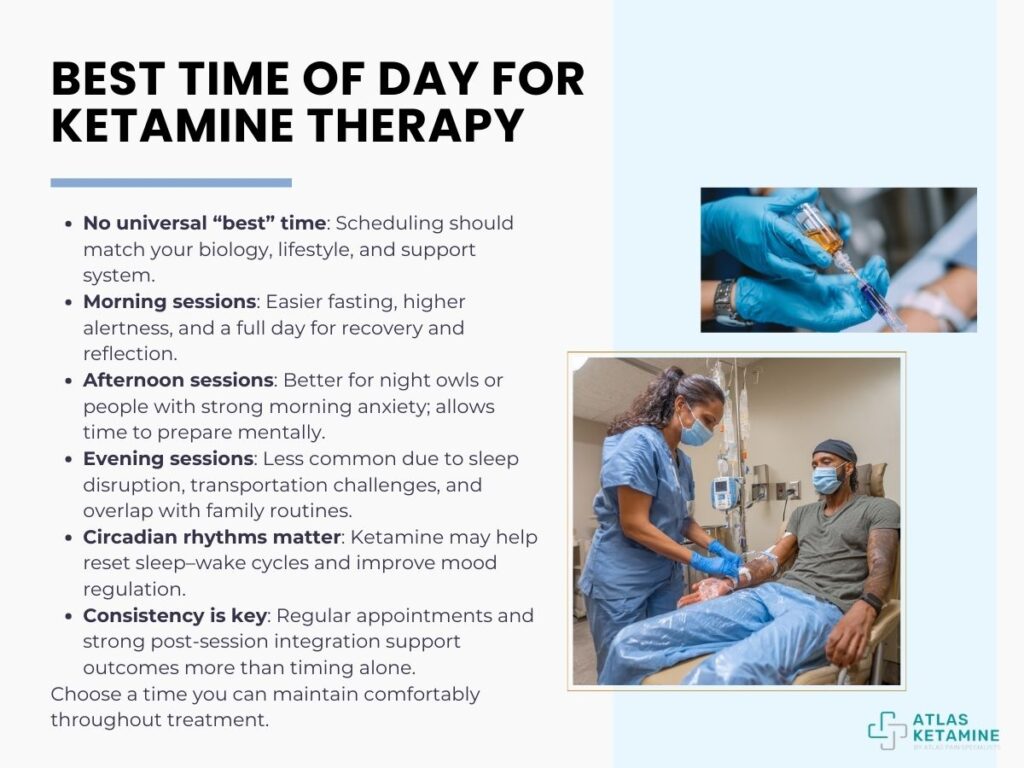
What the Science Says About Circadian Rhythms
The relationship between ketamine and the body's internal clock is a focal point of contemporary psychiatric research. A growing body of evidence suggests that the drug's efficacy is not merely a function of molecular interaction but is also tied to the temporal architecture of the brain.
Ketamine may both influence and be influenced by this internal clock.
Ketamine as a Chronobiotic Agent
Emerging evidence suggests ketamine may act as a chronobiotic, helping reset a misaligned circadian rhythm. A 2024 study in Therapeutic Advances in Psychopharmacology followed patients with treatment-resistant depression through eight IV infusions.
Using the Morningness-Eveningness Questionnaire (MEQ), researchers found a significant shift toward morningness after treatment. This phase advance correlated with improvements in depressive symptoms, indicating that circadian resetting may be part of ketamine’s therapeutic mechanism.
Specific Improvements in Sleep
Using the Pittsburgh Sleep Quality Index (PSQI), the same research identified measurable improvements in:
- Sleep duration: Increased total sleep time, suggesting restoration of disrupted sleep homeostasis.
- Daytime dysfunction: Reduced impairment during the day, reflecting better translation of sleep into energy and alertness.
These findings suggest ketamine’s effects on sleep are targeted and restorative rather than simply sedating.
- Morning Appointments
While chronobiology provides a useful framework, everyday logistics often play a larger role in choosing an appointment time. Morning sessions are widely preferred because they align with a natural fasted state, higher alertness, and a full day available for recovery. These factors together tend to support a smoother and more manageable treatment experience.
The Fasting Requirement
Most clinics recommend limiting food intake for four to six hours before an infusion to reduce nausea risk, since ketamine can disrupt normal gastric function.
- Morning advantage: Overnight sleep naturally creates the required fasting window. Patients can wake, hydrate, and attend their appointment without skipping a planned daytime meal.
- Afternoon complication: Later appointments require patients to remain without substantial food for several waking hours, which may be challenging for those managing blood sugar or taking medications with food.
- Protocol alignment: A morning slot satisfies fasting guidelines passively, while an afternoon slot requires more deliberate planning.
Alignment with Natural Energy Peaks
Cortisol levels rise in the early morning, increasing alertness and engagement.
- Patients often arrive with greater baseline clarity, which can support intention-setting before the session begins.
- The peak effects of treatment occur during the body’s natural rise in energy rather than during evening fatigue.
- For many people, cognitive sharpness is strongest in the morning, which may help with processing insights from the experience.
The Recovery Window
The cognitive and motor effects of ketamine can persist for several hours after the infusion ends. Morning appointments keep this recovery period within daytime hours.
- Patients can return home early, allowing time for rest and reflection.
- Evening responsibilities such as meals or family activities are less likely to be disrupted.
- Lingering fatigue or dizziness has time to resolve before the next day’s obligations.
Consistency and Adherence
The induction phase often requires a condensed schedule of multiple weekly sessions over several weeks. Standing morning appointments create a predictable routine that is easier to coordinate with work and family.
Morning slots are less prone to delays that accumulate later in the day. Making the commitment early may reduce cancellations that occur when decision fatigue builds in the afternoon.
- Afternoon
Although morning sessions offer clear logistical advantages, many patients and clinicians prefer afternoon scheduling. Circadian biology varies widely, and for some individuals the afternoon aligns more naturally with their internal rhythms, emotional baseline, and daily responsibilities.
Accommodation of Evening Chronotypes
Circadian preference exists on a spectrum, with roughly 20 percent of people identifying as evening types who reach peak alertness later in the day. For these individuals, early appointments can feel physiologically misaligned.
- Evening chronotypes often show reduced cognitive flexibility and higher stress when forced into early activity.
- An afternoon session allows full wakefulness to develop naturally.
- Preserving normal sleep timing may support overall recovery and neuroplastic adaptation.
For true night owls, the afternoon may represent their optimal functional window.
Management of Morning Anxiety
Some patients experience pronounced cortisol surges in the early morning, resulting in heightened anxiety and physiological tension. Entering an infusion during this window can feel destabilizing.
An afternoon appointment allows:
- The morning cortisol peak to subside.
- Time for grounding practices and intentional preparation.
- Greater emotional regulation at the start of the session.
In these cases, treatment functions as a structured reset placed at a more stable point in the day.
Work and Family Logistics
Employment and caregiving demands often make morning sessions difficult. Afternoon appointments can provide a practical compromise.
- Patients can complete morning responsibilities before treatment.
- Parents may coordinate more easily around school schedules.
- A recurring afternoon absence may be less disruptive than a morning one in certain roles.
Consistency across the induction phase remains more important than the specific hour chosen.
Clinic Flow and Atmosphere
Clinic dynamics also shift throughout the day. Mornings can feel tightly scheduled, while afternoons may operate at a steadier pace.
Some patients find that later sessions allow for slightly more relaxed preparation and recovery, contributing to a smoother overall experience.
- Evening and the Rest of Your Day
Evening appointments are the least common option in ketamine therapy. This pattern reflects a combination of physiological, logistical, and practical constraints. While late-day sessions remain necessary for a small subset of patients, most clinics reserve them for exceptional circumstances rather than routine induction schedules.
Extended Recovery Demands
The acute effects of ketamine do not end when the observation period concludes. Cognitive slowing, impaired coordination, and altered perception can persist for hours.
- Driving prohibition: Patients cannot legally or medically drive for the remainder of the day, which effectively eliminates evening independence.
- Reduced executive function: Complex decision-making, financial tasks, and important conversations should be postponed.
- Physical safety concerns: Balance and spatial awareness may remain compromised, increasing fall risk during typical evening activities at home.
When treatment occurs late in the day, the recovery window overlaps almost entirely with normal evening responsibilities.
Interference with Sleep
Ketamine promotes cortical activation and heightened neuroplasticity, states that do not naturally support sleep onset. Evening administration places peak stimulation close to bedtime.
- Mental and emotional processing may remain elevated for hours.
- Reflection and integration extend into the period normally reserved for winding down.
- Difficulty falling asleep can compromise both recovery and next-day functioning.
For many patients, protecting sleep quality is essential during induction.
Disruption of Household Routines
Evenings often contain concentrated family and relational responsibilities.
- Family dinners and bedtime routines may be displaced.
- Partners or caregivers may assume additional responsibilities.
- The household must reorganize around the patient’s reduced availability.
Repeated disruption during a multi-week induction phase can create avoidable stress.
Transportation Complications
Safe transportation after infusion is mandatory. Coordinating this requirement becomes more complex after dark.
- Designated drivers may be less available in the evening.
- Waiting for rides in dimly lit commercial areas can feel uncomfortable.
- Fatigue combined with nighttime logistics increases practical risk.
Daylight discharge generally presents fewer barriers.
When Evening May Be Appropriate
Despite these drawbacks, evening appointments are sometimes necessary.
- Maintenance-phase patients who understand their recovery pattern may tolerate late sessions without sleep disruption.
- Individuals with rigid work schedules may have no viable daytime option.
- Clinics may offer limited evening hours to preserve access for these patients.
In most cases, evening scheduling represents a trade-off rather than an optimal choice. Consistent access to treatment remains the priority, but when flexibility exists, earlier hours tend to support smoother recovery and integration.
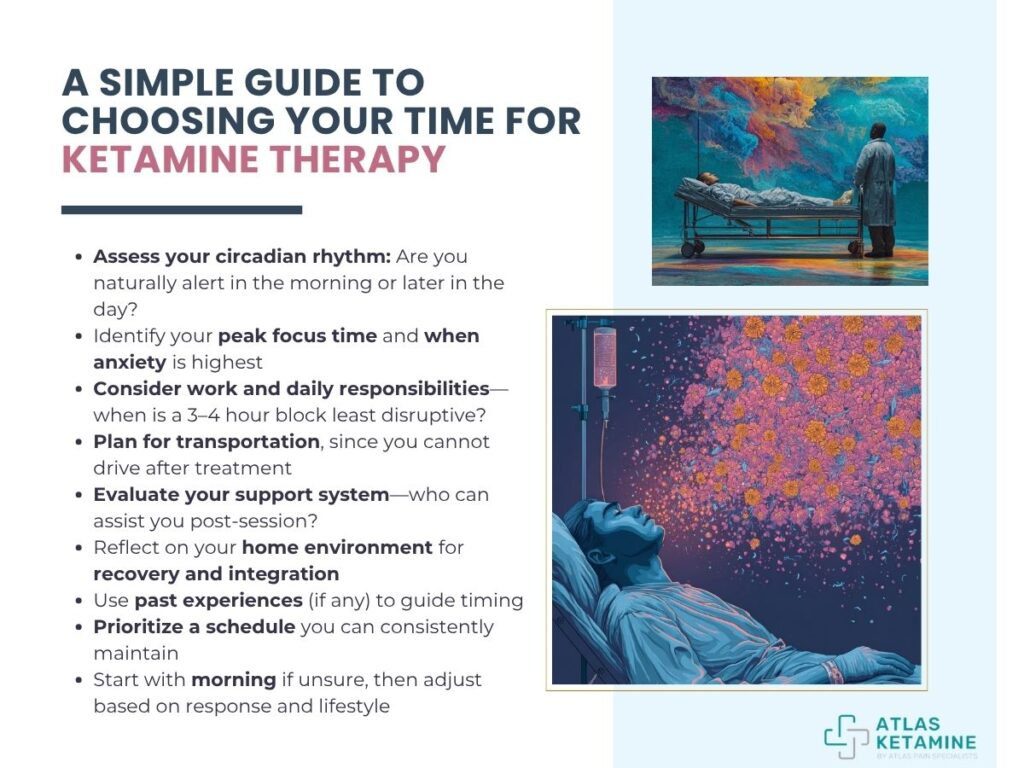
A Simple Guide to Choosing Your Time
Selecting an appointment window requires balancing biology, logistics, and treatment structure. The goal is not to find a theoretically perfect hour, but to choose a time that supports consistency, recovery, and integration.
The following framework translates key variables into practical questions you can use to guide your decision.
Questions About Your Biology
Your circadian rhythm influences alertness, mood, and stress reactivity. Begin by assessing your natural tendencies.
- Do you wake before your alarm feeling alert, or do you rely on multiple snoozes and feel groggy for an extended period?
- When do you experience peak focus for demanding mental tasks?
- Have early commitments historically left you feeling dysregulated for the rest of the day?
- Is your anxiety strongest upon waking, or does it build gradually as the day progresses?
Early chronotypes with stable mornings often do well with morning appointments. Confirmed evening types who feel foggy until late morning may benefit from afternoon scheduling, even if morning slots appear more convenient.
Questions About Your Daily Responsibilities
Practical constraints can override ideal biological timing. Sustainable scheduling matters more than theoretical alignment.
- Which part of the day would a recurring three to four hour absence least disrupt your work?
- Who will manage childcare, meals, or household duties during your recovery period?
- Is reliable transportation available at all times of day, or only during specific windows?
- How much uninterrupted time do you realistically need after each session?
A schedule that repeatedly strains employment or family systems increases stress and reduces adherence.
Questions About Your Support System
Post-session support enhances the neuroplastic window that follows treatment.
- Will someone be available to drive you home and remain accessible afterward?
- Are integration or psychotherapy appointments available within 48 hours of your infusion?
- When is your home environment predictably quiet and conducive to reflection?
If morning sessions lead to solitary recovery but afternoon sessions allow for immediate support, that difference may outweigh other considerations.
Questions About Your Treatment History
If you have prior experience with ketamine, use it.
- Did you feel activated and mentally sharp after sessions, or fatigued and sedated?
- How long did coordination and concentration remain affected?
- Did appointment timing influence your sleep quality?
- Were fasting and nausea manageable at certain times of day?
Personal response patterns provide the most reliable guidance for future scheduling.
A Practical Starting Matrix
For those beginning treatment without prior data, the following general patterns can guide initial scheduling:
- Early chronotype, flexible work, reliable morning ride: Morning. Maximizes recovery time and simplifies fasting.
- Late chronotype, rigid work schedule, daytime support limited: Afternoon. Aligns with biological preference and preserves employment stability.
- High morning anxiety, history of sleep sensitivity: Afternoon. Avoids cortisol surge and protects sleep onset.
- No daytime availability, maintenance phase, predictable response: Evening. Accepts trade-offs to maintain access.
- Uncertain chronotype, flexible schedule, first series: Morning. Offers the greatest margin for recovery and can be adjusted later.
Commit to a consistent schedule for several sessions, observe sleep quality, emotional regulation, and integration capacity, and adjust in collaboration with your provider. The objective is sustained access within a structure that protects recovery and maximizes therapeutic engagement.
Conclusion
There is no universal “best” time for ketamine therapy. Morning sessions suit early risers with natural fasting and alertness, afternoons support night owls or those with morning anxiety, and evenings are generally reserved for maintenance patients with limited daytime availability.
Research suggests ketamine may partly act by resetting the circadian clock, with timing influencing sleep quality and depressive symptoms, though findings remain preliminary. Chronobiology should inform scheduling, but it is only one factor among many in optimizing outcomes.
Consistent attendance and engagement during the 48–72 hour neuroplasticity window outweigh the specific hour of infusion. Integration practices, therapy, rest, and support networks determine long-term recovery more than the clock, making adherence and post-session work the primary drivers of success.