
Ketamine does not significantly promote muscle growth and, in many cases, may actually work against your progress by impairing training performance and recovery. Although limited early research suggests it might influence certain muscle-related pathways, there is no strong human evidence showing it leads to increased muscle size, strength, or hypertrophy in practical settings. In reality, its effects on coordination, intensity, and consistency make it more likely to hinder rather than help muscle-building efforts.
Does ketamine affect muscle growth? This article briefly covers how muscle growth works, ketamine’s direct and indirect effects, differences between therapeutic and recreational use, fitness community perspectives, its impact on exercise adaptations, and potential long-term health risks.
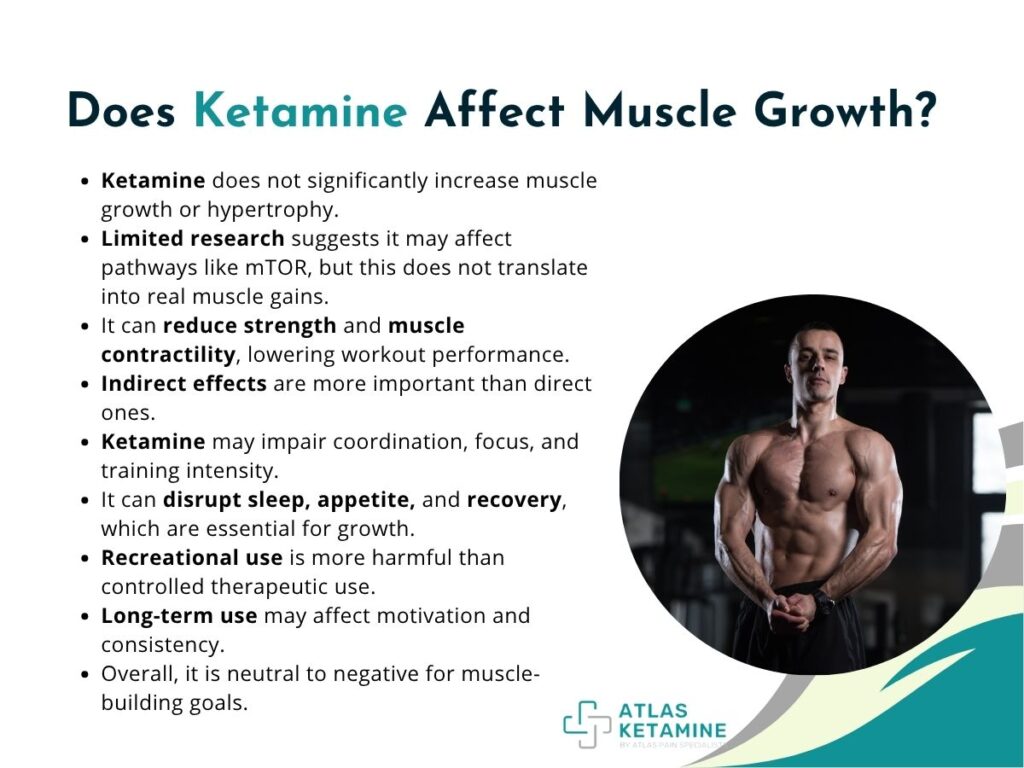
Understanding Muscle Growth (Hypertrophy)
Muscle growth, or hypertrophy, occurs when muscle fibers adapt to stress by becoming larger and stronger. This process is driven by a balance between training stimulus, recovery, and internal biological signaling.
- Mechanical tension (resistance training): Muscle growth is primarily triggered by tension created during resistance exercises like weightlifting. Consistent overload signals muscles to grow.
- Muscle protein synthesis (MPS) vs breakdown: Growth occurs when protein synthesis exceeds breakdown over time. Adequate protein and training help maintain this positive balance.
- Recovery factors (sleep, nutrition, hormones): Muscles grow during recovery, supported by good sleep, proper nutrition, and balanced hormones. Poor recovery limits progress.
At the center of these processes is mTOR signaling, which regulates muscle protein synthesis and plays a key role in hypertrophy. Understanding these basics highlights how disruptions to training or recovery can affect muscle growth.
Direct Effects of Ketamine on Muscle Tissue
Ketamine’s direct impact on muscle tissue is still not fully understood, with limited and sometimes conflicting research. Most findings come from laboratory or animal studies, making it difficult to draw firm conclusions for real-world muscle growth.
1. Possible Anabolic Signaling (Early Evidence)
Some animal studies suggest ketamine may activate pathways like mTOR, which are associated with muscle protein synthesis. This could indicate a potential for supporting muscle-building processes at a cellular level. However, this evidence is limited to short-term studies and does not confirm actual increases in muscle size or strength in humans.
2. Anti-Proliferative Effects on Muscle Cells
In certain contexts, ketamine has been shown to inhibit cell growth and proliferation. This raises concerns that it could interfere with muscle repair or regeneration after training. Such effects may counteract any potential anabolic signaling observed in other studies.
3. Effects on Muscle Contraction
Research indicates ketamine may reduce muscle contractility and force production. This could negatively impact strength output and overall training performance. Over time, reduced training quality may limit the stimulus needed for muscle growth.
Overall, while ketamine may influence some muscle-related pathways, the evidence is inconsistent and largely inconclusive. Its direct effects are unlikely to significantly enhance muscle growth and may even be detrimental in certain aspects.
Indirect Effects That Matter More
While ketamine’s direct effects on muscle tissue are unclear, its indirect effects are far more relevant in real-world muscle growth. These factors influence how well you train, recover, and stay consistent - key drivers of hypertrophy.
1. Training Performance
Ketamine can impair coordination, focus, and reaction time due to its dissociative effects. This makes it difficult to train with proper intensity and technique. Over time, reduced workout quality means a weaker stimulus for muscle growth.
2. Recovery & Lifestyle Factors
Frequent use may disrupt sleep patterns, appetite, and daily routines. Poor sleep and inconsistent nutrition directly limit muscle repair and growth. Even small disruptions in recovery can significantly slow progress.
3. Hormonal & Nervous System Effects
Ketamine alters nervous system activity, including stress and sympathetic responses. This can affect recovery, fatigue levels, and overall readiness to train. Chronic imbalance may indirectly hinder muscle-building potential.
In practice, these indirect effects have a much greater impact than any minor biochemical changes. Consistency, quality training, and proper recovery matter most - and ketamine use can interfere with all three.
Therapeutic vs Recreational Use
The impact of ketamine on muscle growth can vary significantly depending on how it is used. Medically supervised (therapeutic) use is typically controlled and infrequent, whereas recreational use often involves higher doses and less consistency - leading to very different outcomes for fitness and recovery.
Key Differences
| Factor | Therapeutic Use | Recreational Use |
| Dosage | Low, clinically controlled | Often higher and variable |
| Frequency | Occasional, scheduled | Frequent or binge patterns |
| Supervision | Medical oversight | No supervision |
| Purpose | Treat conditions like depression | Recreational or escapism |
| Lifestyle impact | Minimal disruption | Often disruptive |
Impact on Muscle Growth & Fitness
| Aspect | Therapeutic Use | Recreational Use |
| Training performance | Generally unaffected if timed properly | Often impaired due to coordination and focus issues |
| Recovery | Minimal impact in most cases | Can disrupt sleep, nutrition, and recovery habits |
| Consistency | Easier to maintain routine | Often leads to inconsistent training |
| Overall muscle growth | Likely neutral | Potentially negative over time |
In summary, therapeutic ketamine use under medical supervision is unlikely to significantly affect muscle growth when managed properly. In contrast, recreational use poses a much higher risk of disrupting the key habits - training, recovery, and consistency - that are essential for building muscle.
What Does the Fitness Community Say?
Within fitness and bodybuilding communities, ketamine is generally not viewed as a performance-enhancing substance. Most discussions focus on its potential to disrupt training consistency, recovery, and overall discipline rather than any benefits for muscle growth.
- Muscle-building effectiveness: Most lifters agree ketamine has no real anabolic benefits. It is not considered useful for gaining muscle or improving strength.
- Training performance concerns: Many report that its effects on coordination and motivation make effective training difficult. This is seen as a major barrier to progress in the gym.
- Recovery and lifestyle impact: Community feedback often highlights poor sleep, inconsistent routines, and reduced discipline as key issues. These factors are widely recognized as harmful to muscle-building goals.
- Comparison to other substances: Unlike steroids or stimulants sometimes misused in fitness circles, ketamine is not associated with performance enhancement. It is generally viewed as counterproductive for athletic development.
The fitness community largely agrees that ketamine offers no benefit for muscle growth and is more likely to interfere with the consistency and recovery needed for progress.
Interaction with Exercise-Induced Adaptations
Exercise creates physiological changes that improve strength and muscle growth through muscle repair, neural learning, and cellular signaling. Ketamine may interact with some of these processes, but evidence in humans is limited.
- Muscle repair and adaptation: Muscle repair depends on coordinated recovery and inflammatory signals. Ketamine may potentially disrupt these processes, though this is not well confirmed in humans.
- Neural adaptations (strength gains): Strength gains rely heavily on nervous system efficiency and motor learning. Since ketamine alters brain signaling, it could theoretically affect coordination and skill development.
- Cellular signaling (growth pathways): Training activates growth pathways like mTOR that support muscle protein synthesis. Some animal research suggests ketamine may interact with these pathways, but real-world effects remain unclear.
Ketamine’s interaction with exercise adaptations is mostly theoretical, with its biggest impact likely coming indirectly through reduced training quality and consistency.
Long-Term Health Risks Relevant to Fitness
Long-term ketamine use can affect several systems in the body that are important for athletic performance and muscle growth. While not all users experience these issues, they are more commonly associated with frequent or heavy use.
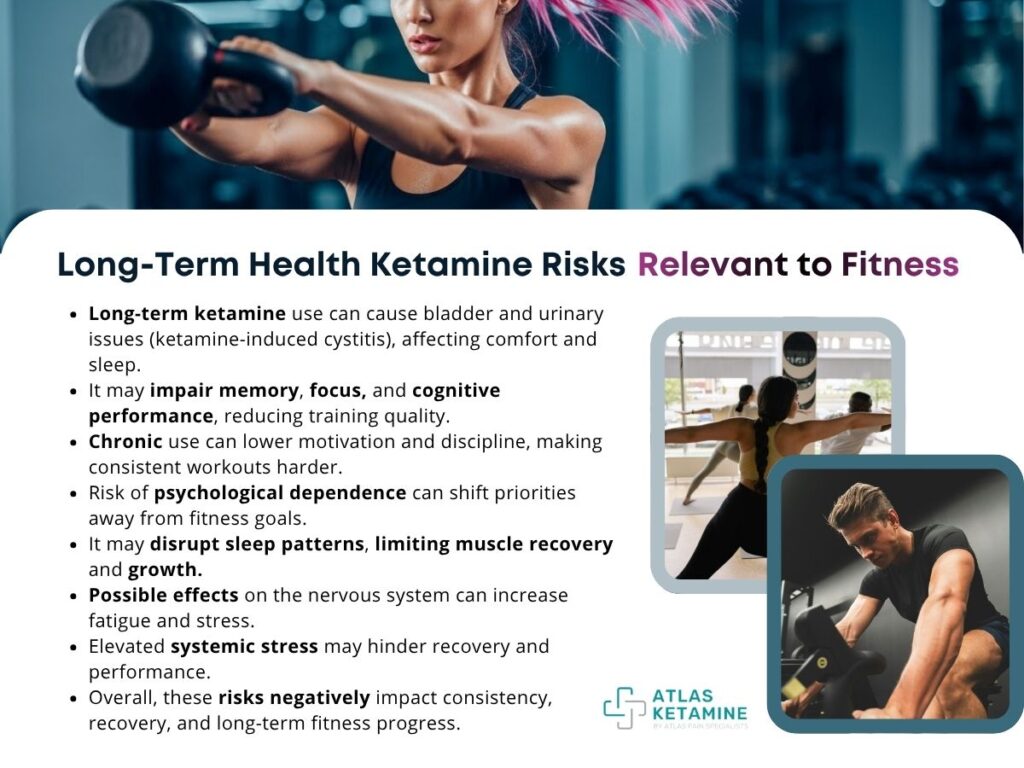
1. Urinary and Bladder Problems
Chronic use has been linked to bladder irritation and pain, known as ketamine-induced cystitis. This can disrupt sleep, training consistency, and overall quality of life.
2. Cognitive and Motivational Effects
Long-term use may affect memory, focus, and motivation. This can reduce training discipline and make it harder to stick to fitness routines.
3. Dependency and Lifestyle Disruption
Some users may develop psychological reliance, leading to reduced priority on training, nutrition, and recovery. Over time, this can significantly stall or reverse fitness progress.
4. Hormonal and Systemic Stress
Repeated use may contribute to elevated stress responses in the body. Higher stress levels can impair recovery and negatively affect muscle-building processes.
These long-term risks are less about direct muscle effects and more about how they interfere with the habits and systems needed for consistent fitness progress.
Final Verdict
Short answer:
Ketamine does not meaningfully enhance muscle growth, and current evidence does not support any real-world anabolic (muscle-building) benefit. In fact, its overall impact is more likely to be neutral at best - and potentially negative - especially when it interferes with training quality, recovery, and consistency.
Key Takeaways
- No strong human evidence shows ketamine improves muscle size, strength, or hypertrophy.
- Any theoretical anabolic signaling seen in early animal research is not enough to translate into practical muscle gains.
Evidence Summary
| Effect | Evidence |
| Direct muscle growth stimulation | Weak (limited animal-based mTOR signaling data) |
| Muscle cell growth | Possibly inhibited in certain tissue contexts |
| Strength/contractility | May be reduced in some studies |
| Real-world hypertrophy outcomes | Likely neutral to negative due to indirect effects |
While ketamine may show limited biological effects in experimental settings, it is not a muscle-building agent. For most people focused on fitness, its main impact is the potential to disrupt the training, recovery, and consistency needed for muscle growth.
Bottom Line
Ketamine does not have any meaningful effect on increasing muscle growth, and there is no strong evidence that it enhances strength, hypertrophy, or overall athletic performance. While a few early studies suggest it may interact with certain muscle-related cellular pathways, these findings are limited to experimental settings and do not translate into practical muscle-building benefits in humans.
Overall, its effects are at best neutral and may become counterproductive depending on use patterns. More importantly, building muscle relies on consistent training, quality recovery, and disciplined lifestyle habits. Since ketamine can negatively affect coordination, sleep, motivation, and routine in some individuals, it is far more likely to indirectly slow progress rather than support it.