
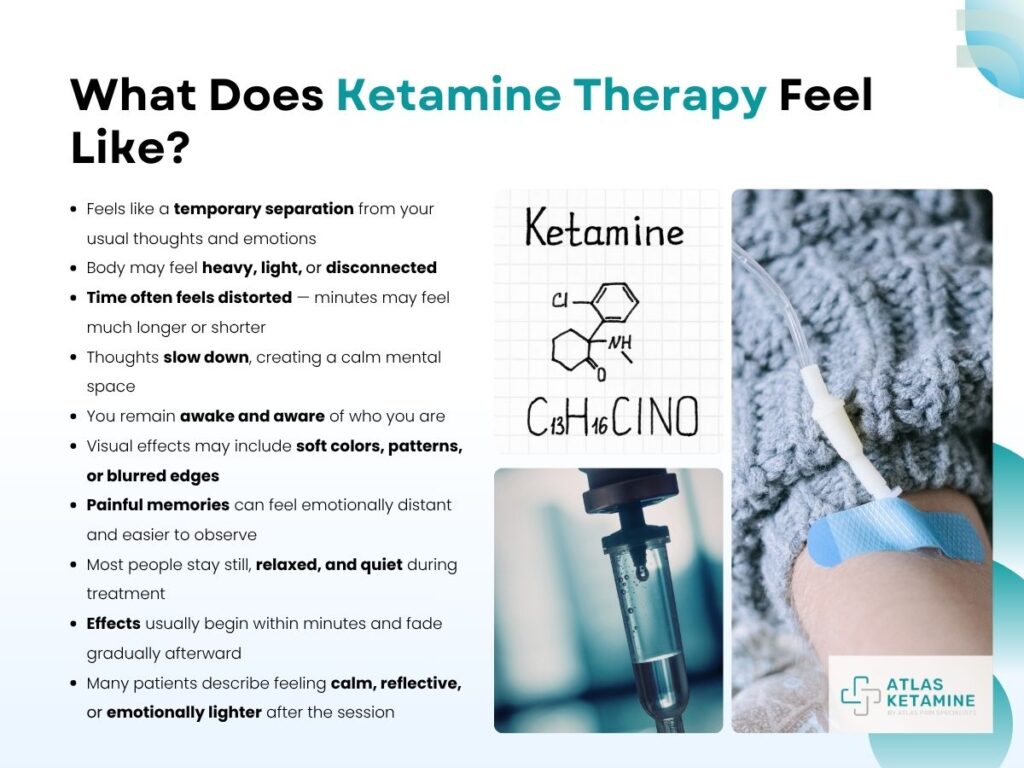
Ketamine therapy feels less like a drug high and more like a temporary separation from your usual self. You remain aware of who you are, but the sharp edges of emotion and memory soften without disappearing.
The first sensation is often a gentle pull away from your body. Your limbs feel distant, and the room around you may seem to stretch or subtly shift.
What does ketamine therapy feel like? Time becomes unreliable during the experience. A single minute can feel extended, or an entire hour can pass in what seems like a few slow breaths.
Let’s Start With Your First Worry
The most common fear before a first session involves a loss of control. You might worry that ketamine therapy feels like an unpredictable drug trip from movies or street horror stories.
Clinical ketamine therapy operates under strict dosing protocols. A medical professional adjusts the amount to your weight and medical history so the experience stays within a safe range.
- You Will Not Lose Consciousness
Your eyes may close during the session but you remain awake. A nurse can speak to you and you can answer back with short responses.
Complete unconsciousness only occurs at anesthetic doses which are much higher than therapy doses. The therapy range keeps you aware even as your perception shifts dramatically.
- You Will Not Act Out of Control
Your body feels heavy or disconnected which makes large movements difficult. Most patients lie still with their eyes closed for the majority of the session.
- No walking around the room
- No shouting or sudden movements
- No unsafe behaviors
The sedation effect keeps you calm and physically quiet. A medical professional stays in the room to monitor your safety at all times.
- You Can Stop at Any Time
You retain the ability to communicate discomfort during the session. A simple phrase like stop or pause alerts the medical team to end the infusion.
The medicine clears from your system quickly once the IV stops. Within ten to fifteen minutes the intense effects begin to fade.
- The Minutes After the Dose
The first noticeable shift happens within two to five minutes after the dose. Your vision may soften at the edges and sounds from the room become distant or muffled.
| Time Period | What You Typically Feel |
| First 2 to 5 minutes | Softened vision, distant sounds, heavy or floating body sensation |
| Minutes 5 to 20 | Peak effects: slowed thoughts, visual patterns, time distortion, emotional distance from memories |
| Minutes 20 to 40 | Gradual return: thoughts feel more like your own, movement returns slowly |
| Minutes 40 to 60 | Room stops drifting, clear awareness returns, tiredness sets in |
Your body feels disconnected from its usual weight. Some people describe a gentle floating sensation or a heaviness that makes movement feel clumsy.
The transition does not feel sudden or jarring. It arrives like a slow fade rather than a sharp cut or a dramatic change.
- Your Thoughts Stop Racing
The internal monologue that normally runs without pause begins to slow down. You notice gaps between thoughts where silence used to never exist.
A painful memory might surface but it does not pull you into its emotional current. The thought sits in front of you like an object you can examine or ignore.
This quiet mental space is often the first sign that something has changed. You do not fight your thoughts because there is nothing to fight.
- The Feeling of Being Separate From Your Body
You remain aware of where your hands and feet rest against the chair. But those sensations register as distant information rather than immediate physical feedback.
Some patients describe the sensation as sitting slightly behind their own eyes. The body feels like a vehicle that continues to run while you sit in the passenger seat.
Attempts to move your arm or adjust your position feel slow and uncoordinated. Most people learn quickly to remain still and let the medicine work without interference.
- Seeing Without Closed Eyes
Visual changes occur even with your eyes closed. Soft geometric patterns or slow color shifts appear against a dark background.
Open eyes see the room as stable but altered. Edges of furniture might blur or light sources may leave brief trails when you turn your head.
These visuals do not form recognizable scenes or characters. They stay abstract and gentle without the chaotic intensity of classic hallucinogens.
- Old Memories Show Up Differently
A difficult memory from your past might rise to the surface without warning. The memory appears clear but the usual emotional pain does not accompany it.
| Sense | Normal State | During Ketamine Therapy |
| Sight (eyes closed) | Darkness with occasional random phosphenes | Soft geometric patterns, slow color shifts, pulsing light fields |
| Sight (eyes open) | Stable room with sharp edges | Edges blur, light sources leave brief trails, objects breathe gently |
| Hearing | Clear sounds with distinct direction | Sounds feel distant or muffled, voices echo slightly, silence expands |
| Touch | Precise location of your limbs | Limbs feel far away, the chair feels distant, body feels heavy or floating |
| Time | Steady minute by minute progression | Five minutes feels like an hour or an hour feels like five minutes |
| Emotion | Sharp reactions to painful memories | Painful memories lose their sting, you watch without being pulled under |
You can look at a traumatic event as if it happened to someone else. The memory loses its sharp sting and becomes just another piece of information.
This detached view of old wounds allows new perspectives to form. You might see your younger self with compassion instead of shame or regret.
- Time Gets Strange
The clock on the wall becomes a confusing object. Five minutes can stretch into what feels like an hour of interior experience.
Conversely an entire hour might pass in what seems like a few slow breaths. You stop checking the time because the concept loses its meaning.
This distortion of time is one of the most universal effects of ketamine therapy. Your brain simply stops measuring duration in the usual way.
- The Hard Part to Describe
Some patients report a sense of deep connection to everything around them. Others feel nothing except a quiet empty space with no emotion at all.
The same person can have two completely different experiences across different sessions. One visit might feel warm and expansive while the next feels neutral and flat.
This unpredictability frustrates many first time patients. The lack of a consistent feeling is actually a normal part of how the medicine works.
- Coming Back to Your Body
The return to normal awareness happens slowly over twenty to forty minutes. Your thoughts begin to feel like your own again instead of distant observations.
Movement returns to your limbs in small increments. You might wiggle your fingers first then your toes then finally open your eyes fully.
The room stops its gentle drift and objects hold still. You recognize where you are and why you came there for the first time since the session started.
- The Hours After the Session
A sense of tiredness often settles in once the acute effects wear off. Your body feels like it completed a long workout even though you remained still.
Your emotional state can vary widely during this recovery window. Some people feel unusually calm and clear while others notice raw sadness or sudden tears.
Hydration and rest are the two most important needs in this period. A light meal can help ground you but heavy food might feel unpleasant.
What It Is Not
Many patients arrive with expectations shaped by movies or street drug stories. Clinical ketamine therapy differs from those portrayals in several specific ways.
| Common Fear | What Actually Happens |
| Loss of consciousness | You remain awake and can answer simple questions |
| Terrifying hallucinations | Abstract patterns and color shifts without monsters or scenes |
| Panic or racing heart | Calm or neutral state with stable vital signs |
| Acting out or losing control | Still and quiet body with heavy or disconnected limbs |
| Forgetting who you are | Full awareness of your name, history and reason for treatment |
- Not a Hollywood Hallucination
You will not see monsters, demons or cartoon creatures. The visuals remain abstract like geometric patterns or soft color shifts without any threatening forms.
A person having a bad trip in a film loses all contact with reality. A patient in a clinical session can still answer questions and follow simple instructions.
- Not a Panic Attack
The medicine does not spike your heart rate or trigger shortness of breath. Standard doses produce a calm or neutral state rather than a fear response.
- No sudden jolts of adrenaline
- No sense of impending doom
- No urge to escape the room
Your vital signs are monitored throughout the session. A nurse or doctor can stop the infusion immediately if any distress appears.
- Not a Loss of Identity
You remain aware of your name, your history and why you came for treatment. The experience feels like watching your own mind from a slight distance rather than disappearing into it.
Some people worry they will act out in embarrassing ways. Clinical data shows patients stay still and quiet for nearly the entire session.
- Not a Party Drug Experience
Recreational ketamine doses are often much higher than medical protocols. Clinical therapy uses precise amounts based on body weight and treatment goals.
Recreational use frequently involves snorting powder or taking unknown pills. Medical ketamine is administered through an IV, an injection or a lozenge under direct supervision.
Best Time of Day for Ketamine Therapy
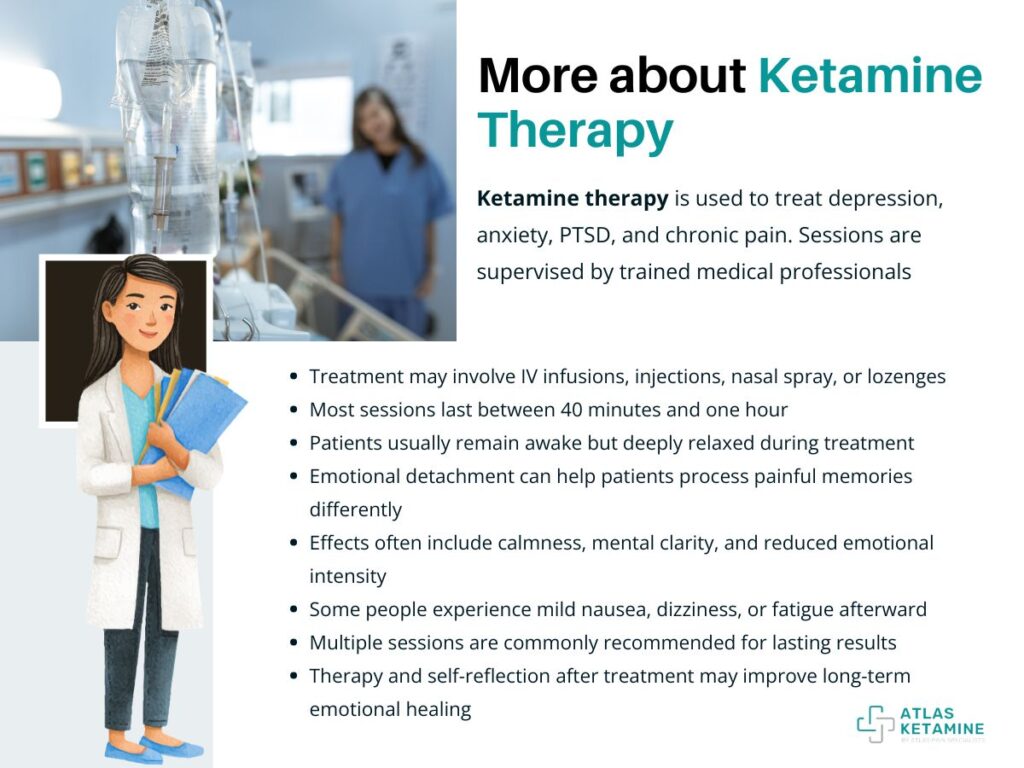
The core feeling of ketamine therapy is not a cure but a temporary separation from your usual mental patterns. That separation creates just enough space for old wounds to loosen their grip without disappearing entirely.
A morning session allows the afterglow effects to unfold across a full day of wakefulness. You can integrate the experience through walks, meals or conversations rather than fighting sleepiness.
An afternoon session works well if you need time to manage morning anxiety before treatment. The choice depends on your personal schedule but the therapy itself feels the same regardless of the hour.